EXTEMPORE PLAYING - online tutorial
40 Lessons in how to correctly play improvisations.
| Share page | Visit Us On FB |
|
Enharmonic Changes |
119 |
||
|
major third below the lowest, and representing the domi- |
|||
 |
|||
|
But, as on the keyboard the distance between a minor 3rd and an augmented 2nd is the same, inversion will make no change in sound. Therefore, any tone may be regarded as leading-tone with the root a major third below; thus: |
|||
 |
|||
|
Here the convenience of change of notation comes in. To avoid the use of so many double-flats the last two may |
|||
 |
|||
|
effect.
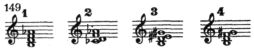
Now rewrite the last three so as to sound on the same pitch as No. 1: |
|||
 |
|||
|
and we have a genuine case of enharmonic changes. Each of these chords is a dominant, and will go to its tonic, major or minor; i.e., the original four notes may be resolved to eight different keys.
To turn now to the other chords of superimposed minor thirds (or diminished sevenths), we find the altered II7 |
|||
 |
|||